Brief #079 · A · B · C
Twice the engine. Same boat. Barely faster. Why?
Boat handling
Answer: A. Near her hull speed, about 1.34 × √(waterline in feet) knots, 8.3 knots on this yacht's 38-foot waterline, the wave she makes at her bow is as long as her waterline: she sits in the trough between her bow wave and her stern wave, her stern squats, and to go faster she has to climb her own bow wave, so her wave-making resistance rises at a very high rate. On his 46-foot yacht Nigel Calder measured 26 to 32 hp at the propeller shaft for 7.28 knots and 55 to 74 hp for 8.28 knots: more than twice the power for one knot. Not B: a 56 hp diesel weighs about 150 kg more than a 30 hp one, about 1 percent of a 14-tonne yacht, and resistance at a given speed grows with her weight, so about 1 percent more. Not C: skin friction is only 20 to 30 percent of her resistance at these speeds and grows smoothly, roughly with the square of her speed; if it were all, twice the power would give about a quarter more speed, over 9 knots.
A displacement hull under engine: a cruising sailboat, or a trawler-style motor yacht. Planing boats, and very fine, light hulls such as racing kayaks, are not held to hull speed in the same way.
Transcript
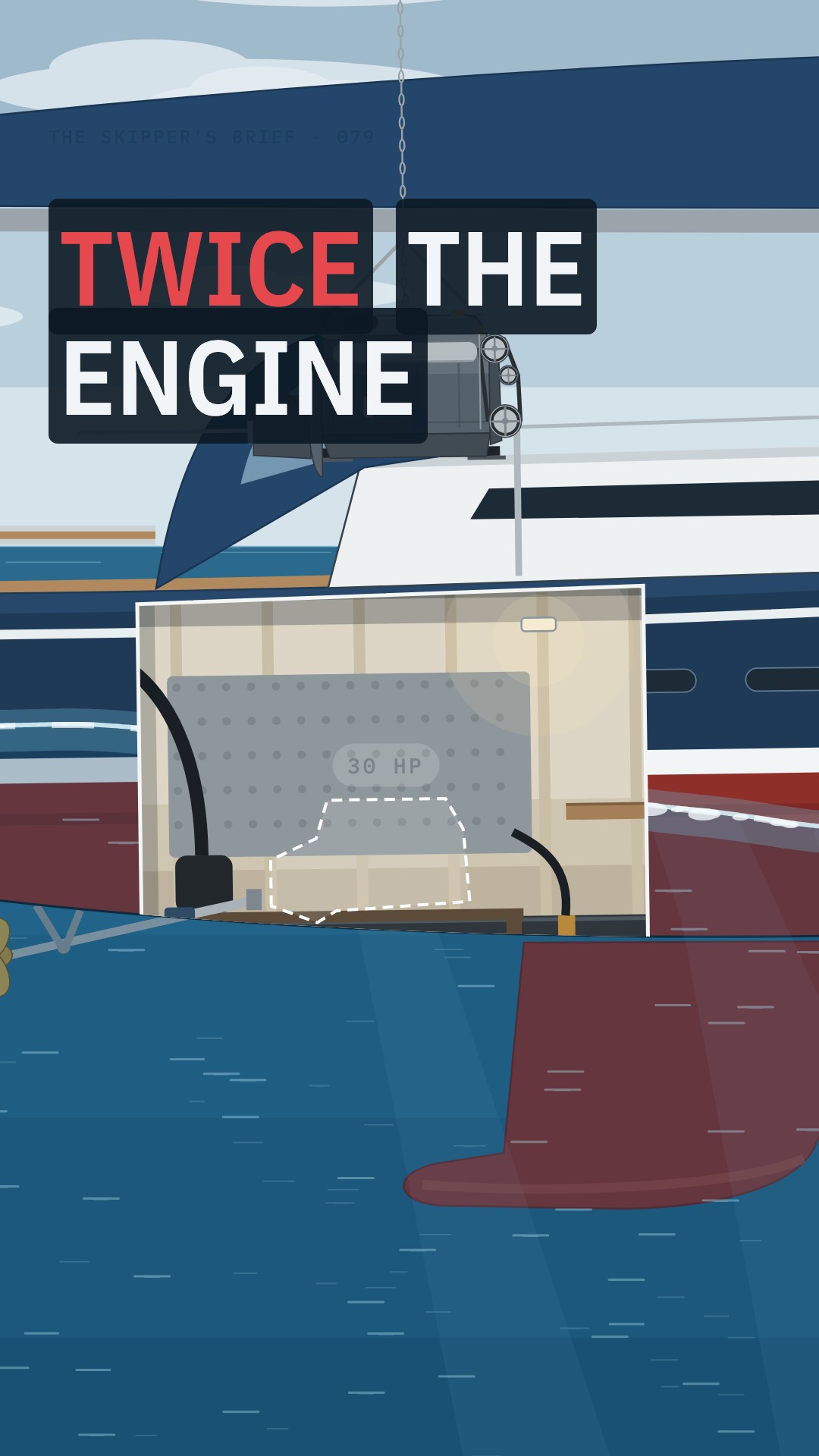
Give this boat an engine twice as powerful, and she's barely any faster. Why?
7.3 knots took about 30 horsepower. 8.3 took over twice that.
Is it her own wave? Is she stuck in it?
Is it the extra weight? Is it holding her back?
Or is it the water? Does it stick to her hull?
A, B or C? Tell me in the comments, and why you think so. Follow, so you don’t miss the answer.
Sources
- SAIL magazine, Nigel Calder, 'Just slow down' (1 February 2010): his 46-foot yacht has 'a waterline length of 38.25 feet', so 'a nominal hull speed of 1.34 x 6.18 = 8.28 knots'. Measured with eight propellers, hull speed 'takes between 55 and 74 hp at the propeller shaft'; at 7.28 knots 'The power demand drops to between 26 and 32 hp, less than half as much'. Wave-making energy 'rises rapidly as the wave length approaches the waterline length'; beyond it 'it takes enormous amounts of energy'. The reel's 7.3 and 8.3 knots are his 7.28 and 8.28 rounded; the drawn boat is a generic 46-foot cruising yacht with the same waterline
- Good Old Boat, Ted Brewer (yacht designer), 'How much power?' (Issue 37, July/August 2004; back issues free to read): owners repowering 'almost always decide to put in bigger engines', but 'the change rarely brings the anticipated result'. His resistance table, in pounds per ton of displacement by speed/length ratio: 17 at 1.00, 22 at 1.10, 33 at 1.20, 54 at 1.30, 70 at 1.35. 'At these speeds, the frictional resistance is 20 to 30 percent of the total and residuary resistance (wave making) is 70 to 80 percent.' A full stern is needed 'to prevent squatting as the speed/length ratio approaches 1.34'
- Wikipedia, Hull speed: 'the speed at which the wavelength of a vessel's bow wave is equal to the waterline length of the vessel'; past it, 'a vessel in displacement mode will appear to be climbing up the back of its bow wave'; about 1.34 × √(waterline in feet) knots; 'This very sharp rise in resistance at speed/length ratio around 1.3 to 1.5' made it seem a barrier. The article adds that drag rises smoothly, often with no clear kink at hull speed, and that fine, light hulls can exceed it
- Wikipedia, Wave-making resistance: past a speed-length ratio of 1.34 'the stern is no longer supported by the wake, causing the stern to squat, and the bow to rise. The hull is now starting to climb its own bow wave, and resistance begins to increase at a very high rate.' Driving a displacement hull faster 'is prohibitively expensive'
- FAO Fisheries Technical Paper 383 (J.D.K. Wilson), Fuel and financial savings for operators of small fishing vessels: the effort spent making waves 'increases very rapidly' with speed, so 'a large increase in power is required to achieve a small increase in speed'; the maximum speed of a displacement hull is about 2.43 × √(waterline in metres) knots. Skin friction is the second most significant resistance
- Wikipedia, Skin friction drag: the drag is the skin friction coefficient times the dynamic pressure ½ρv², and the coefficient slowly decreases as the Reynolds number (speed) rises, so friction grows smoothly, a little less than with the square of speed. Our arithmetic: if friction were all, power would grow with about the cube of speed, so twice the power would give 2^(1/3) ≈ 1.26 times the speed: 7.28 knots to about 9.2
- Beta Marine, Beta 30 marine diesel: '30 hp @ 3,600 rpm', 139 kg (one maker's figures, used as an example of a 30 hp engine)
- Beta Marine, Beta 60 marine diesel: '56 hp @ 2,700 rpm', 287 kg: 148 kg more than the 30 hp Beta 30 (one maker's figures, as an example of an engine about twice as powerful)
- Rocna Knowledge Base, Malö 46 Classic (the make of Calder's yacht): displacement 14.1 tonnes (31,100 lb). 148 kg is about 1 percent of that; Brewer's table gives resistance per ton of displacement, so about 1 percent more resistance