Brief #102 · KNOT OF THE WEEK
Tie up to a cleat like a pro
Boat handling
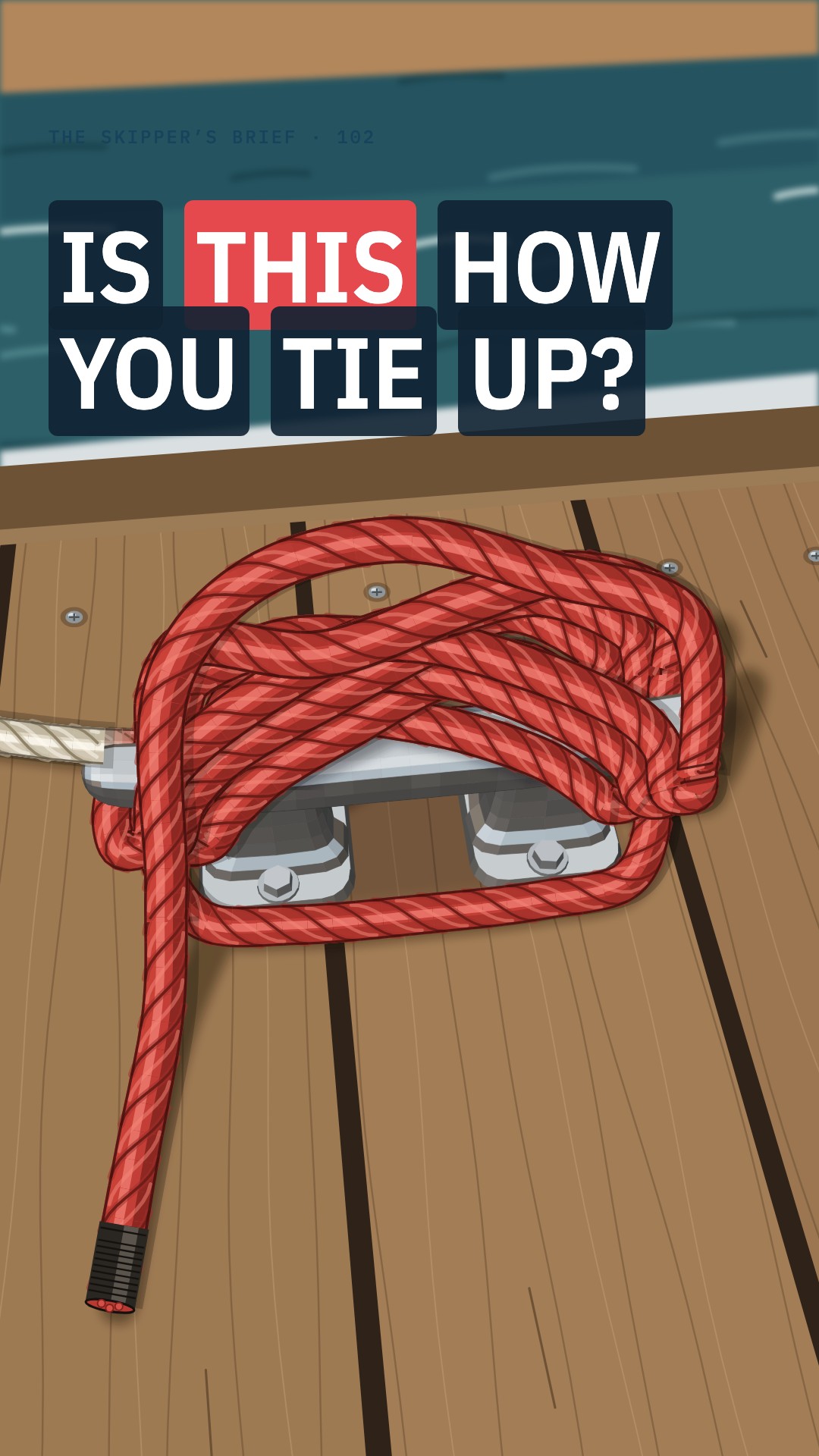
The cleat hitch in three moves, from the tier's side of the cleat: lead the line to the far horn first (the horn away from the load) and take a full turn round the base; cross over the top and round the other horn in a figure eight; finish with a locking hitch, a small underhand loop dropped over the horn, so the end lies neatly alongside the crossing beside it. Done right it holds, won't jam and comes off in seconds; hitch after hitch until the cleat is full can jam under load, just when you need the line off (48° North; U.S. Coast Guard Boat Crew Handbook; Discover Boating; Practical Sailor; Wikipedia).
Transcript
Is this how you tie up to a cleat? Here's how the pros do it, in three moves.
One: lead the line to the far horn first, then take a full turn round the base.
Two: cross over the top and round the other horn, in a figure eight.
Three: twist a loop, end underneath, and drop it over the horn. Pull it tight.
Check it: the end lies neatly alongside the turn next to it.
Done right, it holds, and it won't jam. Flip the hitch off, and it's free in seconds, even with the boat pulling.
The common mistake: hitch after hitch, until the cleat is full. Under load, that can jam, just when you need it off fast.
Follow the page for next week's knot.
Sources
- Wikipedia, Cleat hitch: the hitch 'begins with a dead turn around the cleat then continues forming an "8"', and 'is finished with an inverted half hitch'; releasing: non-jamming
- Wikipedia, Cleat (nautical): the horn cleat, two horns parallel to the deck; its photo of a dock line round both horns and hitched notes that it is tied improperly: the line from the boat should first go to the far side of the cleat, not the near side
- U.S. Coast Guard, Boat Crew Handbook: Seamanship Fundamentals (BCH 16114.4, 2017), copy on the Coast Guard Auxiliary's District 7 site: securing a line to a cleat, 'make a complete turn around the cleat', then lead it over the top and round the horn to form a figure eight; make fast so the line 'can neither slip nor jam'; cleats sized at 1/16 in of line per inch of cleat
- Alex Wilken, 48° North, The Ins-and-Outs of Using Your Horn Cleats (2020): take the working end to the far horn first, 'far horn, both horns, full figure eight, and lock it'; don't take excessive turns or lock it more than once ('lock after lock back and forth on both horns completely filling the cleat' can make untying quickly impossible); a lock whose lines cross instead of lying neatly alongside one another isn't reliable; 'Put one turn of the line on a cleat and you can hold almost anything'
- Discover Boating (NMMA), How to Tie a Cleat Hitch Knot: take the line round the cleat on the side away from the load, make figure-eight wraps across the horns, finish with a small underhand loop slipped over the horn, then pull the end tight; don't skip the final half hitch
- Darrell Nicholson, Practical Sailor, How Do You Cleat a Line on a Boat? (2011, updated 2019): the finishing half hitch 'aligns the diagonal of the previous wrap'; cleat the same way every time so 'a line can be cast off quickly in the dark of night in an emergency'