Brief #070 · DISTRESS
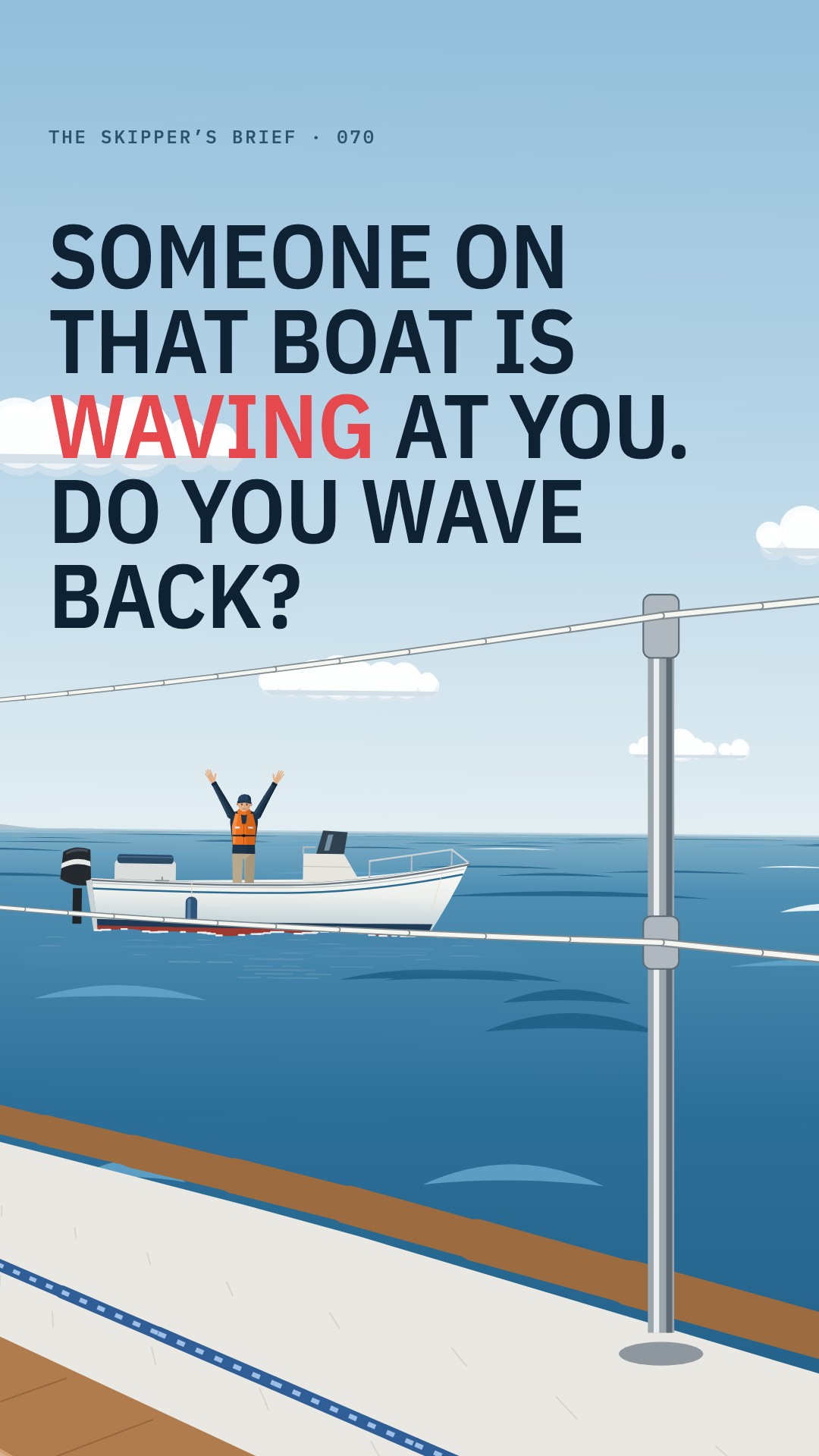
Someone on that boat is waving at you. Do you wave back?
Safety
Someone on a boat is waving at you. Before you wave back, look at the arms. A friendly wave is one hand, side to side. Both arms outstretched to the sides, raised and lowered slowly and over and over, is a distress signal in the collision rules, on the same list as red flares and Mayday. It's easy to mistake for a wave, so if in doubt, go and check if it's safe to, and tell the coastguard. In April 2026 a fisherman on an upturned hull, about four nautical miles off Swanage, was spotted waving for help by a passing yacht. Her crew sent a Mayday, and another fishing boat picked him up.
International rules (COLREGs). Inland waters can have their own rules.
Transcript
Someone on that boat is waving at you. Do you wave back?
It's a real question from the test at theskippersbrief.com.
Not until you've looked at the arms.
A friendly wave is one hand, side to side.
This is both arms, out to the sides. Raised and lowered, slowly, over and over.
That means: help me.
It's in the rules, on the same list as red flares and Mayday.
In April, off Swanage, a fisherman was waving from an upturned hull. A passing yacht saw him, and sent a Mayday. Another boat picked him up.
If in doubt, go and check, and tell the coastguard.
Worst case, you've said hello.
Try three free questions at theskippersbrief.com.
Sources
- COLREGs Annex IV, Distress signals: 1. 'The following signals, used or exhibited either together or separately, indicate distress and need of assistance': (e) 'a signal sent by radiotelephony consisting of the spoken word "MAYDAY"'; (i) 'a rocket parachute flare or a hand-flare showing a red light'; (k) 'slowly and repeatedly raising and lowering arms outstretched to each side'. 2. 'The use or exhibition of any of the foregoing signals, except for the purpose of indicating distress and need of assistance and the use of other signals which may be confused with any of the above signals, is prohibited.' (International text, Canada's Collision Regulations, Schedule 1)
- COLREGs Rule 37, Distress signals: 'When a vessel is in distress and requires assistance she shall use or exhibit the signals described in Annex IV' (International text, Canada's Collision Regulations, Schedule 1)
- The Skipper's Brief, Lights and Signals course, module 'Distress signals': 'A person in a small boat keeps doing this, slowly, over and over. What does it mean?', options Hello: a friendly wave / I'm in distress: help me / Slow down: your wash / Keep clear: I'm fishing. Answer: 'Lifting both arms out to the sides and lowering them again, slowly and over and over, is a distress signal. It is easy to mistake for a wave, so if in doubt, go and check.' (paid part of the course; every course starts with 3 free questions, no sign-up)
- Wikipedia, Wave (gesture): 'People wave by raising their hand and moving it from side to side' – secondary
- Wiktionary, wave (verb): 'To move one's hand back and forth (generally above the shoulders) in greeting or departure' – secondary
- Swanage News, 'Fisherman rescued from upturned sinking boat near Swanage' (17 April 2026, on Tuesday 14 April 2026): 'the 24 foot fishing boat' 'capsized approximately four nautical miles out at sea from Swanage in Dorset'; 'he was spotted waving for help by a passing yacht'; 'The yacht's crew issued a Mayday call'; 'another fishing vessel had managed to recover the casualty from the barely floating upturned hull'
- RNLI, 'Person rescued from hull of capsized fishing boat 4nm offshore' (14 April 2026): a passing yacht saw the casualty waving for help and made a Mayday call, received by HM Coastguard; the Swanage all-weather lifeboat launched, and another fishing vessel recovered the casualty before it arrived (read through search excerpts: the page blocks direct fetches)
- Hong Kong Leisure and Cultural Services Department, Maritime Distress Measures: 'raise and lower both arms at each side of the body slowly and repeatedly'; if you see someone giving these signals, 'please inform the rescuers' and 'under safe circumstances, provide assistance as far as possible'
- RYA, SOLAS V regulations, Regulation 33: the master of a ship at sea that can help, on receiving information that people are in distress, 'is bound to proceed with all speed to their assistance'; if unable to, the master records why and should inform the search and rescue service. RYA note (MCA guidance, MGN 610): 'this regulation applies to all vessels, including pleasure vessels', and 'requires masters or skippers to respond to information from any source that people are in distress at sea'
- Steve LeBlanc, Associated Press, via WBUR (24 Oct 2024), rescue off Nantucket: 'The man said he'd been sitting on the hull of the capsized boat for about an hour'; 'He said he'd attempted to flag down three other boats, but no one saw him'; two anglers 'saw a pair of hands waving and kicked into action' (used in the post texts only)