Brief #042 · ANCHORING
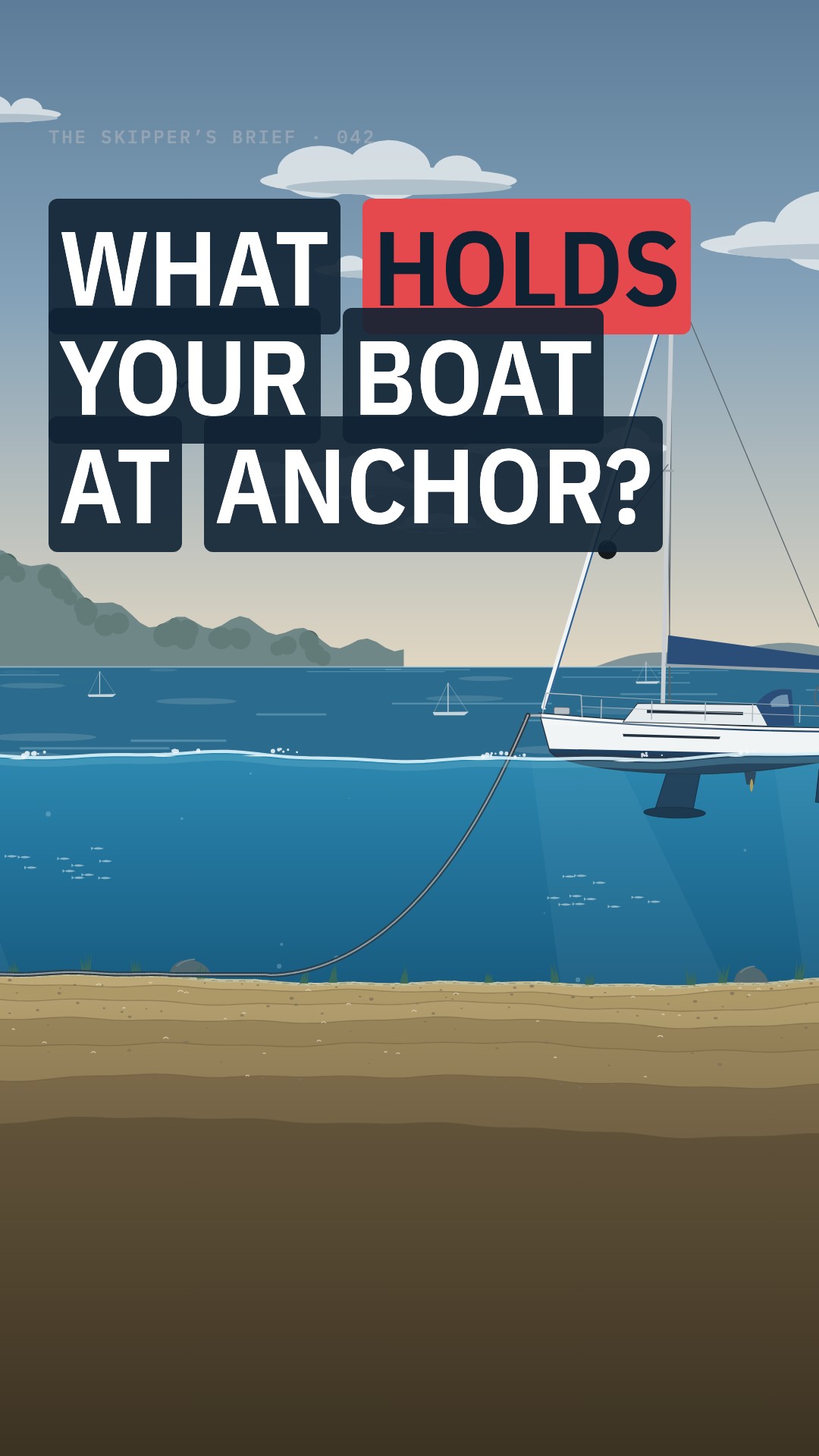
What actually holds your boat at anchor?
Boat handling
Not just the anchor's weight: it holds by digging in like a plough, and only while the pull on it stays flat along the seabed, which is the chain's job; with too little chain the pull tilts up and the anchor breaks out, so let out about four times the depth at high tide in chain and set it by reversing gently.
Transcript
What actually holds your boat at anchor?
Not just its weight. Back in the 1930s, a plough anchor held 62 times its own weight.
It digs in, like a plough, but only if the pull stays flat.
That's the chain's job: its weight sags into a curve, so the pull arrives flat.
In a gust, the curve lifts and cushions the jerk.
Too little chain, and the pull tilts up. Past about 25 degrees, its grip collapses.
So let out about four times the depth at high tide in chain, six with rope, more in strong wind.
And set it by reversing gently.
Want to learn more interesting facts like this? Follow the page.
Sources
- G. I. Taylor (1934), The holding power of anchors, The Yachting Monthly and Motor Boating Magazine, April 1934 ("a surface set at an acute angle to the ground will dig in if pulled horizontally"; his new C.Q.R. plough anchor, 52½ lb, about 24 kg, held 29 cwt in tests, "sixty-two times the weight of the anchor"; in 2¼ fathoms of water on only 5 fathoms of cable it did not take hold). Reproduced by PeterSmith.net.nz
- BoatUS Magazine (2015), Smarter Anchoring (anchors bury themselves and develop holding power when the pull on them is roughly parallel to the bottom; chain's catenary helps keep the pull horizontal and absorbs shock in normal conditions; holding power drops steadily as the angle of pull rises to 25 degrees, then drops precipitously, reached between scopes of 3:1 and 2:1, after Ridsdale Ellis; 5:1 a good starting scope, 7:1 or 8:1 or more in heavy winds, depth measured from the bow; dig the anchor in by motoring gently in reverse)
- RYA with The Green Blue, Anchoring with care (flake out the correct amount of chain, 4 × the maximum depth at high water, or 6 × if using chain and warp)
- Practical Boat Owner (2022), Anchoring a boat: 6 tips to keep you safe (anchors work by orientating themselves on the seabed and digging in, first at the tip; the more scope, the better the holding and the shock-absorbing effect of the catenary; the heavier the rode, the flatter it lies and the straighter the pull on the anchor; too short a scope does not work; guidelines of 3 × the maximum depth for all chain, 5 × for chain and warp, 7 × for rope)
- Vryhof Anchor Manual 2005, via TU Delft OpenCourseWare (a drag embedment anchor's holding capacity comes from the resistance of the soil in front of it; it is very well suited to large horizontal loads but not to large vertical ones; a catenary mooring line arrives at the seabed horizontally, so the anchor sees only horizontal force, and the line's own weight provides the restoring force)
- Yachting Monthly (2019), How much anchor chain? (a length of chain bedded in the sand or mud substantially reduces the pull on the anchor; the RYA suggests a scope of at least 4:1, others 7:1; motor in reverse after anchoring to drive the anchor in)