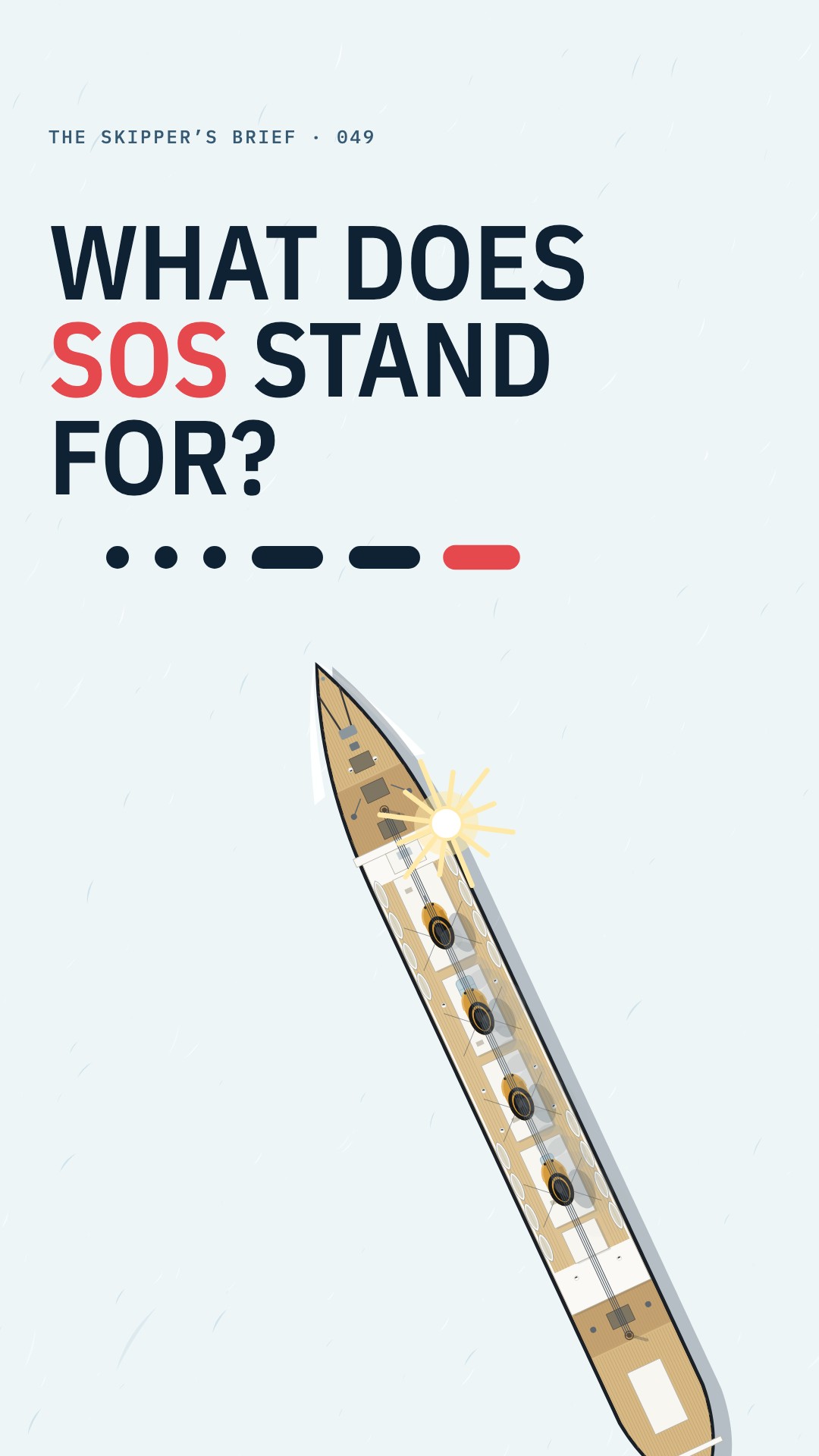
Brief #049 · DISTRESS
What does SOS stand for?
Safety
SOS stands for nothing: it is one unbroken Morse signal, three short, three long, three short, which the International Wireless Telegraph Convention signed in Berlin on 3 November 1906 made the distress signal for ships from 1 July 1908, chosen because the pattern is simple and unmistakable; 'Save Our Souls' and 'Save Our Ship' came later. Titanic's operators sent Marconi's CQD and then added SOS in April 1912, and five days later Marconi told the US Senate inquiry he did not know what SOS means. Today it's Mayday on the radio, but SOS sent by any method still means distress.
Transcript
What does SOS stand for? Save Our Souls?
Nope. It stands for nothing.
It's not three letters. It's one signal: three short, three long, three short.
A 1906 treaty chose it for ships in distress: simple and unmistakable.
Save Our Souls was made up later.
Titanic sent Marconi's CQD, then added SOS.
Days later, Marconi was asked what SOS means: “I do not know.”
Try it: three short, three long, three short.
Today it's Mayday on the radio, but a flashed SOS still means distress.
Want to learn more interesting facts like this? Follow the page.
Sources
- ITU News 6/2006, Pioneers' page, 'Sending out an SOS': 'The “SOS” signal originated in national radio regulations issued in Germany in 1905' and was adopted internationally by the Berlin conference in 1906 ('ships in distress shall use the following signal'); 'It is a continuous group of Morse dots and dashes, rather than separate letters, and was chosen because the pattern is simple and unmistakable. However, because it can be read as “SOS” in Morse code, this became the usual mnemonic for the signal.'; Titanic's John Phillips sent 'CQD' for much of the time and, as suggested by Harold Bride, interspersed it with 'SOS'
- International Wireless Telegraph Convention, done at Berlin, November 3, 1906 (US Government Printing Office, 1907), Service Regulations, Art. XVI: 'Ships in distress shall use the following signal: ··· — — — ··· repeated at brief intervals' (the signal printed as a sign, not as letters); Convention Art. 22 and the Regulations: in effect from 1 July 1908
- Wikipedia: SOS (secondary): German regulations effective 1 April 1905; first International Radiotelegraph Convention signed 3 November 1906, effective 1 July 1908; specified as 'a continuous Morse code sequence of three dots / three dashes / three dots, with no mention of any alphabetic equivalents'; 'initially not an abbreviation. Later a backronym was created … "save our souls" and "save our ship"'; Titanic's Marconi operators intermixed CQD and SOS
- Wiktionary: SOS, etymology: 'chosen merely as a sequence that is easy to recall and transmit'; 'It is not, as is commonly believed, an abbreviation for "save our souls", "save our ship", or any other phrase.'
- Wikipedia: CQD (secondary): the Marconi company's distress call from 1 February 1904 (Circular 57), CQ ('all stations') plus D for distress; never an international standard; on 15 April 1912 Titanic's Jack Phillips initially sent CQD, Harold Bride suggested SOS and Phillips then alternated between the two
- US Senate Titanic Inquiry, Day 2 (20 April 1912), Guglielmo Marconi: C.Q.D. 'is a conventional signal which was introduced originally by my company'; 'the international danger signal, introduced or decided on by the Berlin convention, is S.O.S.' Senator Smith: 'What does that mean?' Marconi: 'I do not know what it means. It denotes danger or distress.'
- US Senate Titanic Inquiry, Day 14 (4 May 1912), Harold Bride's statement: Phillips asked the captain 'if he should use the regulation distress call "C Q D."' and 'started in with "C Q D"'; later 'Again Mr. Phillips called "C Q D" and "S O S"'
- Wikipedia: Titanic (secondary), for the pictures: four buff funnels with black tops, 'only three were functional—the aftmost one was a dummy'; Marconi spark transmitter 'with the wireless telegraph call sign MGY'; 'An elevated T-antenna that spanned the length of the ship'
- US Coast Guard Navigation Center, Navigation Rules (International and Inland), Annex IV, distress signals: '(d) a signal made by any signaling method consisting of the group . . . – – – . . . (SOS) in the Morse Code; (e) a signal sent by radiotelephony consisting of the spoken word “Mayday”'; also a DSC distress alert
- MCA (GOV.UK), GMDSS VHF DSC procedures for small boat users: the DSC distress alert and the spoken Mayday call, 'only to be used in the event of grave and imminent danger and assistance is required'
- IMO, Maritime Safety, Introduction / History: 'The full implementation of the GMDSS on 1 February 1999 was an important date in maritime history'
- Steamship Mutual, Global Maritime Distress and Safety System (GMDSS), June 1999: from 1 February 1999 SOLAS ships of 300 gt and above must use the GMDSS; 'Morse code has not been used in the international search and rescue system since the 1st February deadline'