Brief #034 · BULBOUS BOW
Why do big ships have a bulb under the bow?
Boat handling
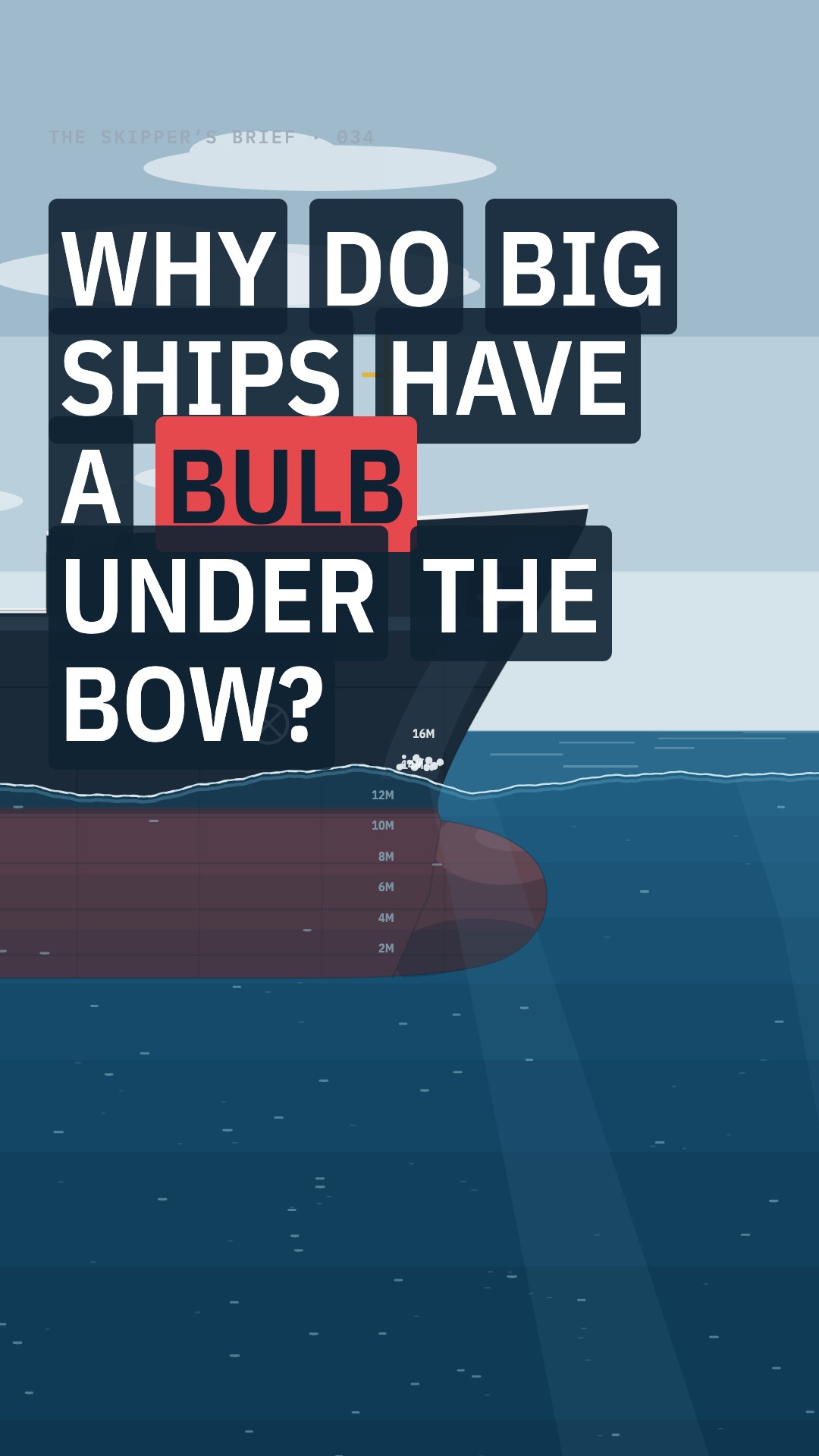
A bulbous bow makes its own wave, out of step with the bow wave, so the two partly cancel and the ship burns less fuel; but it is tuned for one speed, which is why many ships that slowed down had their bulbs replaced, and why easing off near hull speed saves your own boat so much fuel.
Transcript
Why do big ships have a bulb under the bow?
Every ship pushes up a bow wave. That burns fuel.
The bulb makes its own wave, out of step with it.
The two partly cancel: flatter water, less drag.
In Navy tests, a destroyer's bulb saved 6 percent power at 20 knots.
At 10 knots, it cost 16 percent more. It's tuned for one speed.
So as ships slowed down, many had their bulbs cut off and replaced.
Your boat pays too: near top speed, its bow wave grows fast. Ease off one knot and you can halve your fuel.
Want to learn more interesting facts like this? Follow the page.
Sources
- FAO Fisheries Technical Paper 383 (J.D.K. Wilson), Fuel and financial savings for operators of small fishing vessels: wave-making resistance; the effort spent making waves 'increases very rapidly' with speed; the nearer to maximum displacement speed, the larger the gain from slowing down (10 m trawler: 10 % slower, 28 % less fuel per mile)
- MAN Energy Solutions, Basic Principles of Ship Propulsion: wave-making resistance is 'the energy lost by the setting up waves'; it rises steeply above Froude numbers of about 0.16 to 0.17
- ABS, Ship Energy Efficiency Measures Advisory: the bulb produces 'its own wave system that is out of phase with the bow wave from the hull, creating a canceling effect'; bulbs are most effective at a certain speed and draft, and lower speed or draft 'can actually lead to increases in wavemaking resistance'
- PassageMaker, Patrick Bray (naval architect), Bulbous bow basics: 'A bow bulb modifies the bow wave by starting to form a wave ahead of the hull's bow wave'
- Wärtsilä Encyclopedia of Ship Technology, Bow: the bulb develops 'an independent wave system that reduces the total wave system generated by the hull-bulb combination'
- University of Houston, The Engines of Our Ingenuity No. 2715 (Andy Boyd), Bulbous bows: water flowing over the bulb 'creates a trough behind it. This trough reduces the wave generated by the edge of the bow'
- US Patent 5,280,761 (Karafiath & Cusanelli, assigned to the US Navy, 1994), Combined bulbous bow and sonar dome for a vessel: DDG-51 destroyer model, bulb 12.7 ft ahead of the bow, Table 2 effective power +16.15 % at 10 knots and −6.05 % at 20 knots versus the hull without it
- IMarEST, John Barnes, Ram bow revival that became the bulb: 'It is only really effective at one draught'; David W. Taylor and the battleship Delaware of 1910
- Notteboom, Pallis & Rodrigue, Port Economics, Management and Policy, Slow steaming: since 2007 lines cut commercial speeds from 22–23 knots to 18 knots or slower
- Officer of the Watch, Maersk ships get new bulbous bow (12 March 2013): ten Maersk ships; 'replace the entire bulbous bow (200 tons of steel) with one that is adjusted to the ships' actual speed profile'
- MarineLink, Hapag-Lloyd (1 July 2015): 24 of its largest container ships to get new bulbous bows by 2016; built for 25 knots, slow steaming at 16–18 knots
- SAIL magazine, Nigel Calder, Just slow down (2010): measured on his Malö 46 at hull speed (1.34 × √LWL in feet = 8.28 knots), 'It takes half as much fuel to do 7.28 knots instead of 8.28 knots'; 'slow down a knot or two'