Brief #037 · SURVIVAL
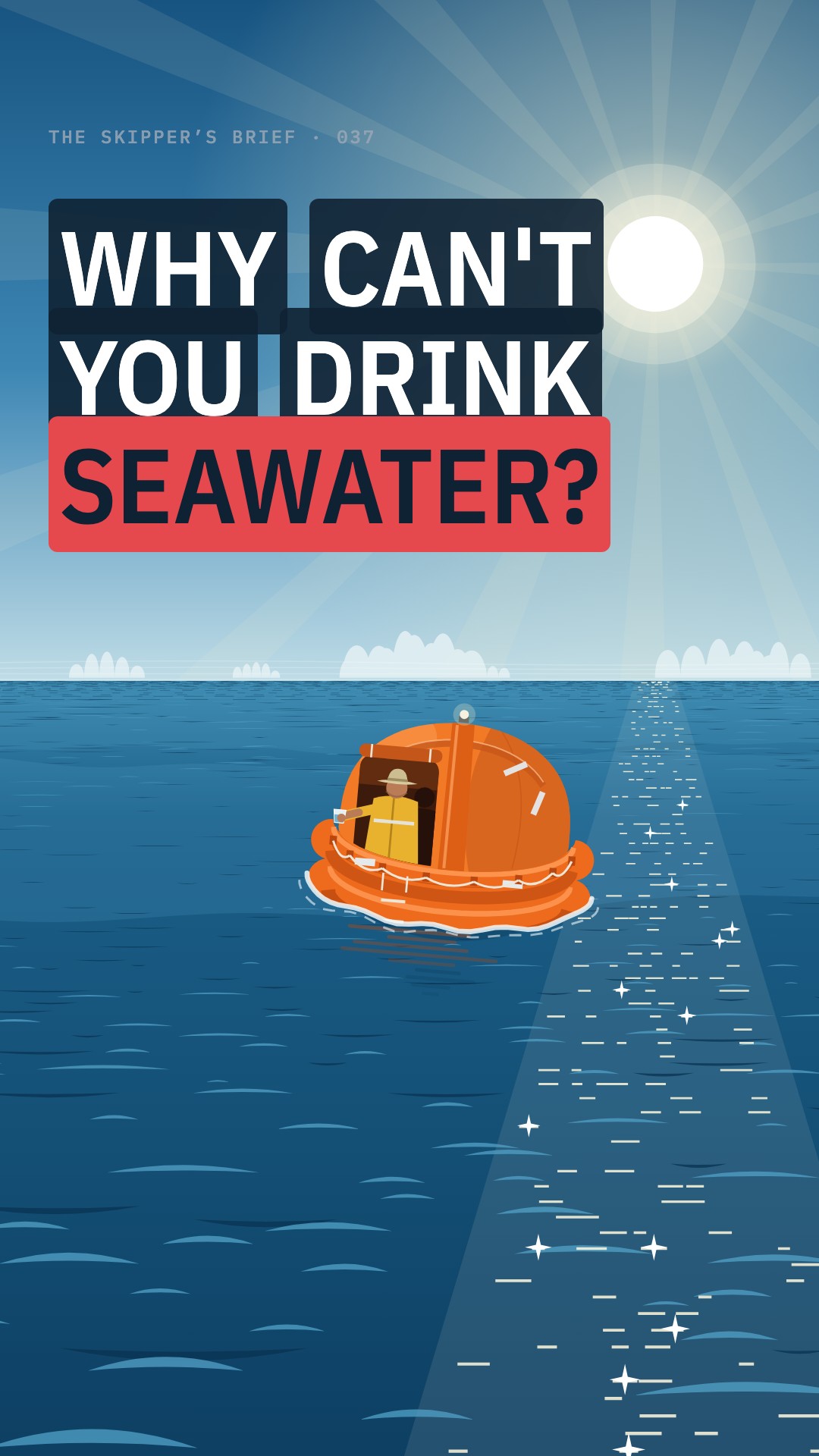
Why can't you drink seawater?
Safety
Seawater is about 3.5% salt, nearly four times saltier than your blood, and your kidneys can only make urine less salty than seawater, so flushing out the salt costs more water than you drank; in a life raft, never drink it: ration fresh water, catch rain and check what your raft carries.
Transcript
Why can't you drink seawater?
Seawater is about 3.5% salt: nearly four times saltier than your blood.
Your kidneys can only make urine that's less salty than seawater.
So to flush the salt out, you pee away more water than you drank.
You end up more dehydrated, and even thirstier.
Adrift in a life raft? Never drink seawater.
Ration your fresh water, catch rain on the canopy, and pump a hand watermaker if you carry one.
And check your raft's pack: some carry no water at all.
Want to learn more interesting facts like this? Follow the page.
Sources
- NOAA National Ocean Service: Can humans drink seawater? (drinking seawater can be deadly; human kidneys can only make urine that is less salty than salt water, so to get rid of the excess salt you have to urinate more water than you drank; eventually you die of dehydration even as you become thirstier)
- NOAA National Ocean Service: Why is the ocean salty? (average salinity about 35 parts per thousand: about 3.5 percent of the weight of seawater comes from the dissolved salts)
- Mental Floss (Ellen Gutoskey, 20 May 2021): What would actually happen if you drank saltwater? Seawater about 35 g of salt per litre, blood about 9 g per litre; Dr Christanne Coffey, UC San Diego emergency medicine: "seawater is four times saltier than blood" (35 ÷ 9 ≈ 3.9). Sources differ a little on the ratio: Live Science says more than three times
- Live Science (John Loeffler, rewritten 23 June 2022): Why can't we drink saltwater? (about 3.5% of seawater's weight is dissolved salt, per NOAA; saltwater contains more than three times the salt normally present in human blood; flushing it out takes more water than you drank)
- Guyton & Hall, Textbook of Medical Physiology, 'Obligatory urine volume' (as reproduced by BrainKart): ocean sodium chloride about 3.0–3.5%, 1,000–1,200 mOsm/L; the kidneys concentrate urine to at most about 1,200 mOsm/L, about half of it urea and other wastes, so they can excrete sodium chloride at only about 600 mOsm/L, less salty than seawater; drinking seawater gives a net fluid loss (about 1 L per litre drunk, on these textbook figures)
- Ocean Safety, Ocean Regatta Liferaft Owner's Manual, Rev 01 (2023): "WARNING: NEVER DRINK SEA WATER"; the raft catches rain in a gutter on the canopy, led inside by a hose with a valve (throw away the first rain); its under-24-hour and SOLAS B emergency packs list 0 drinking water
- IMO International Life-Saving Appliance (LSA) Code, resolution MSC.48(66), 1996: a liferaft canopy "shall be provided with means for collecting rain water" (4.1.1.5.6); a SOLAS A pack holds 1.5 l of fresh water per person, of which 1 l may be replaced by a manually powered reverse osmosis desalinator (4.1.5.1.19), plus a graduated drinking vessel and survival instructions; the reduced SOLAS B pack for short international voyages leaves the water out (4.1.5.3)
- UK Maritime and Coastguard Agency, MGN 77 (M+F): Instructions for action in survival craft (1998), reproducing IMO resolution A.657(16); how to survive in a liferaft: "Decide on food and water rations"